
Clay County VINELink Coverage
Georgia brought VINE statewide in 2024 through its Criminal Justice Coordinating Council. VINE stands for Victim Information and Notification Everyday. The service searches custody records by name. It also sends timely alerts about releases and transfers, with support for multiple languages. The public entry point is VINELink Georgia. The Georgia CJCC announcement lays out the statewide rollout. One tool, one purpose: VINE finds a specific custody record and offers notification. It does not publish a Clay County arrest gallery or a complete daily jail list.
County-level details stay thin. Clay County publishes nothing about its upload interval or the fields it sends to the system. So date what you find and confirm it elsewhere. A Clay County Jail hit is a strong custody lead. A blank screen is different; call the holding agency before assuming no arrest occurred.
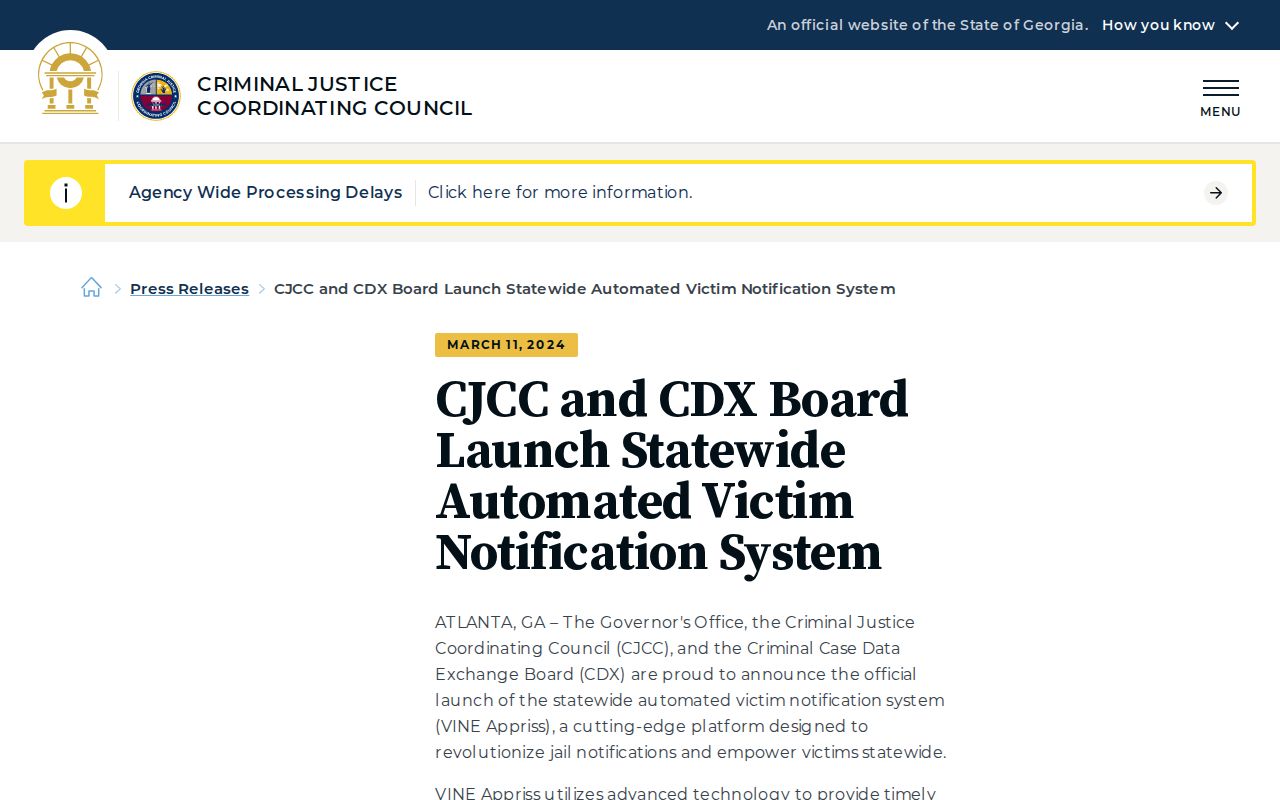
This official state capture supports VINE's notification role, while Clay-specific feed timing remains unverified.
Check Clay County Custody
Start with the person's full legal name. Spell it the way a booking record would show it. Nicknames and misspellings cause misses. If the form offers an extra identifier, use it. That separates people who share a name. Write down when you searched, since custody status can shift within hours.
- Open VINELink and choose Georgia in the state selector.
- Enter the person's name and any additional identifier the current interface permits.
- Compare multiple matches carefully. Check the facility, identifier, and status rather than relying on the name alone.
- Open the matching record and note the custody status, facility, record identifier, and search time.
- If no result appears, try a known spelling variation once, then verify with the Clay County Sheriff's Office.
The Clay County recent-arrest sources map the records VINELink leaves out. Sheriff booking records, bond reports, photo requests, and court dispositions each belong to other offices. VINELink is a custody locator. Open the Georgia VINELink search screen to begin.

The official Georgia search page shows a plain state lookup, with no booking photo gallery attached.
Clay VINELink Result Details
A VINE result answers one question. Is this person in custody? The exact labels come from the live Georgia screen. Clay County has published no field map for its records. Treat the table as a guide rather than a promise. A missing value can reflect timing. It can also reflect participation or the scope of that record.
| Result item | What it can mean |
|---|---|
| Name | The name tied to the custody record; compare other identifiers before selecting a match. |
| Record or offender ID | A useful way to distinguish namesakes and track the same record. |
| Custody status | The status supplied to VINE at the recorded time, subject to update lag. |
| Facility | The agency or site associated with the record; confirm transfers directly. |
| Release or transfer event | A custody change, not a dismissal, acquittal, or final case result. |
| Notification option | The live control used to register through channels currently offered. |
"Released" covers custody only. Charges can still move forward in court. "Transferred" points to another facility or agency holding the live record. The formal case outcome is a court disposition, and only the court can supply it. No alert can substitute for that.
Save what you find with context. Note the state, exact name, identifier, facility, status, and check time. Copy no more personal data than the check requires, and when two records look alike, call the listed facility instead of guessing.
Register for Clay Custody Alerts
Registration begins on the matching custody record. Georgia offers phone, text, email, and app alerts, plus accessibility options. Follow the prompts on the live screen. The listed choices can change. VINE systems use a PIN to manage alerts, so choose one you can recall but no one else could guess.
- Confirm that the open VINELink result belongs to the intended person.
- Select the notify or registration control shown on that record.
- Choose among the phone, text, email, app, or accessibility channels currently offered.
- Enter and confirm the requested contact details, then set a PIN if the interface asks for one.
- Save the registration confirmation and follow the current instructions for testing or managing notices.
Set up more than one contact channel. Alerts fail in ordinary ways. A missed call, full inbox, changed number, or blocked message can stop delivery. A notification alone is not a safety plan. Contact the local victim-services or law-enforcement office and build one separately.
Read every alert fully and finish any confirmation step. Some systems keep calling until a PIN is entered. Clay County publishes no registration manual, so the live VINELink instructions govern. Update contacts after a change, and keep the record identifier so registration can be recovered without a name search.
Clay VINELink Limits
VINELink is not a federal locator. Someone held by the Bureau of Prisons belongs in the BOP's own search. A federal pretrial detainee can sit in a local jail yet answer to the U.S. Marshals Service. Immigration detention is ICE territory. One arrest can even spawn two records when a local booking overlaps a federal hold.
Fresh bookings may not appear right away. Clay County does not publish its upload schedule. A spelling difference, a transfer, or a nonparticipating source can also return nothing. The Clay County Sheriff's Office takes calls at 229-768-2505. Ask three direct questions. Was the person booked at Clay County Jail, is that person still there, and where did the custody record move?
Statewide VINE, Local Clay Timing
Georgia runs its VINE program statewide. What the state announcement does not spell out is how Clay County Jail feeds it, with no published field list, interface guide, or upload schedule for the local facility. So search first. Register when the right record appears. Verify with the sheriff when it does not.
There is no separate Clay SAVIN brand, no sheriff app, and no official booking-alert social channel. Watch for near-miss names. Clay County, Florida is a common false match. Clayton County, Georgia is its own jurisdiction. Before relying on any result, confirm the state is Georgia and that the facility or agency actually serves Clay County.
VINE works best once a matching record exists and someone wants notice of a later change. It is weaker proof of a brand-new booking, since the county's upload interval is unknown. A saved screenshot is only a snapshot. Recheck the live record. Call the agency before leaning on it for anything time-sensitive.
Note: Statewide service and complete county data participation are different claims; only the live source and sheriff can resolve the gap.
Clay Custody Alerts Versus Court Results
A VINE alert covers custody facts, nothing more. It may report a release, a transfer, or an escape. It says nothing about how a case ends. For the legal outcome, use the Clay Superior Court record. A lower court file may be the proper one instead. That is a separate system with separate answers.
Keep the VINELink identifier and the alert time with your note. Just do not merge them with a court disposition. A release notice can land while a case is still pending. A transfer may only change one thing. It shifts which office answers the next custody question about the arrested person.
Confirm a Fresh Clay Arrest
An arrest may have happened hours ago. That calls for a phone call, not a registration. Confirm with the jail directly first. Clay County publishes no public roster and no same-day feed, so the Clay County 24 Hour Arrests process starts with the sheriff. Once the right VINELink record appears, register from that result and keep the confirmation.
Three sources answer three different questions. A booking report shows the intake. VINE tracks a supported custody record. A court docket shows formal filings and whatever outcome follows. Checked together at the right stage, they beat any single automated notice.
If the sheriff says the person has left Clay County Jail, ask where and when. A receiving county jail, a Georgia prison, or a federal agency may use a different identifier. Keep the original Clay booking number with the later record, which builds a chain from the intake event to the new location. No single database updates every other system at once.
Search Public Records
Sponsored Results