
Clay County Recent Arrest Channels
Start with the Clay County Sheriff's Office, since every booking processed through Clay County Jail runs through it. The office prepares booking and bonding reports, hands out inmate information on request, and keeps photographs, fingerprints, and criminal histories. Those duties prove a local arrest record exists. They do not promise an online one. The county offers no 24-hour arrest feed, no rolling roster, no public inmate search, and no mugshot gallery.
Before you search, sort out what you actually need. A same-day question is about present custody. A multi-day question points to an older booking report or news coverage. A court search tracks the filed charge. A GDC search covers state custody after the county stage. Silence in one database never proves an arrest did not happen.
| Channel | Clay County status | What it can establish |
|---|---|---|
| 24 Hour Arrests | No verified official feed | Same-day fallback routes for new county processing |
| Arrest Log | No verified official blotter | Requests and selected, incomplete local reporting |
| Sheriff phone or written request | Verified official path | Current custody and existing booking or bond records |
| VINELink Check | Statewide service; Clay timing not documented | Custody alerts when a record participates |
| Georgia DOC locator | Verified state tool | State correctional custody, not fresh county intake |
When Clay Arrests Appear Online
Clay County's gap is about availability, not timing. No public booking interface comes from the sheriff. That leaves no documented refresh schedule, no weekend update rule, no photo lag, and no roll-off period. A person can finish booking at the jail while nothing searchable appears anywhere online. And an old listing on some outside site says nothing about custody now.
For a recent Clay County arrest, call 229-768-2505. Have the full name ready. Add the approximate arrest date and the arresting agency if you know it. Ask whether the person is in Clay County custody. Ask whether a transfer happened, and which office holds the booking report. The same-day arrest page covers that short window. The multi-day arrest log handles date-bounded searches and regional reports. Neither pretends a live feed exists.
The official sheriff source shows why a phone call is the practical first step.
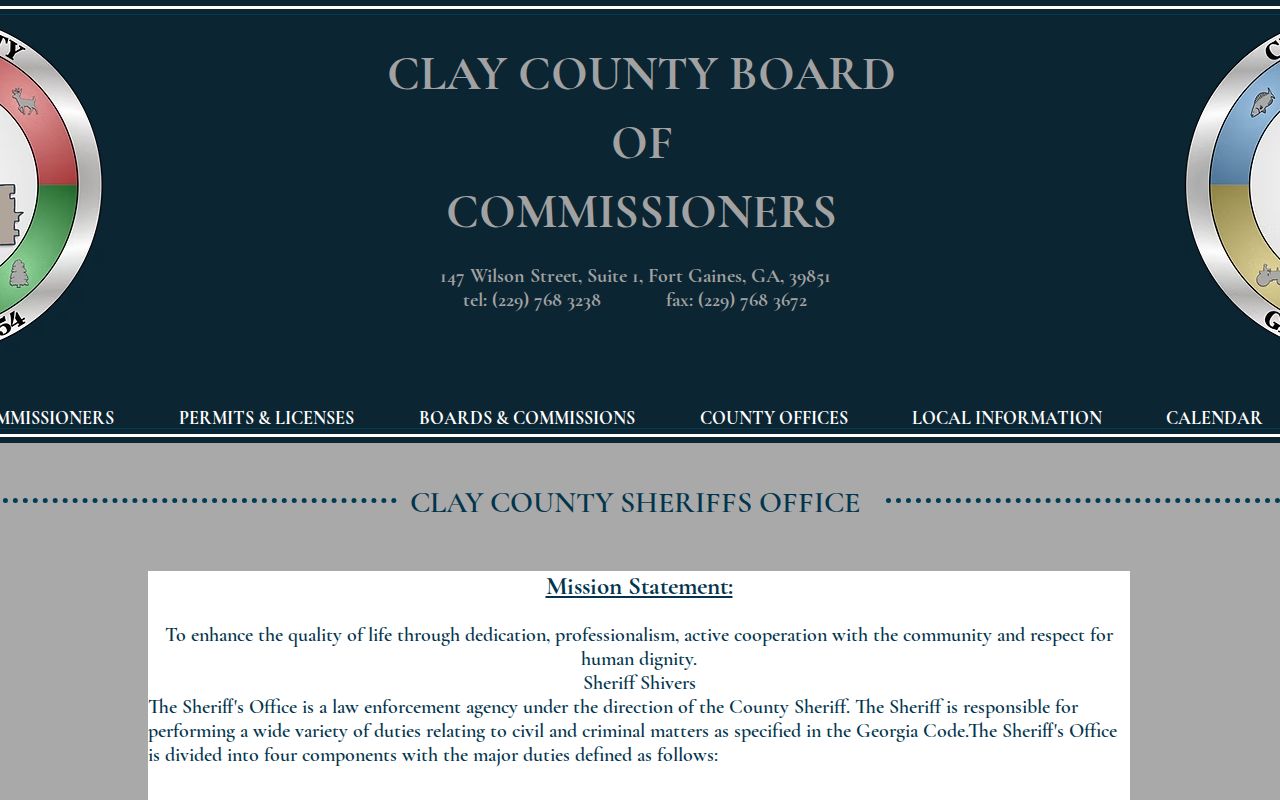
The sheriff's department page lists booking-related duties but offers no roster link, so questions have to go through direct contact and records requests.
Clay County Jail Arrest Roster
Clay County Jail publishes no public arrest roster. The Georgia Department of Corrections facility listing confirms the jail's name. It lists a Fort Gaines mailing address and the sheriff's phone number. Beyond that, it is just a directory entry. It shows no one in custody. It shows no booking photos, no charges, no bond amounts, no court dates, and no release information.
Since there is no results screen to work with, no search fields can be described. Give the sheriff the details instead. Keep the request narrow, and separate present custody from a past booking.
- Use the full legal or booking name and note any spelling variation.
- Give a short date range and identify Fort Gaines or Bluffton only as context.
- Ask which agency made the arrest and whether Clay County Jail completed intake.
- Ask whether the person remains held, bonded out, transferred, or moved elsewhere.
- Request the existing booking report, bond report, and photograph separately if needed.
Booked versus released: a booking means intake at the jail is complete. A release means county custody ended. That can happen by bond, court order, completed sentence, or another authorized route. A name missing online proves neither one.
The official state directory entry helps identify the facility. It keeps the jail separate from the state offender database.
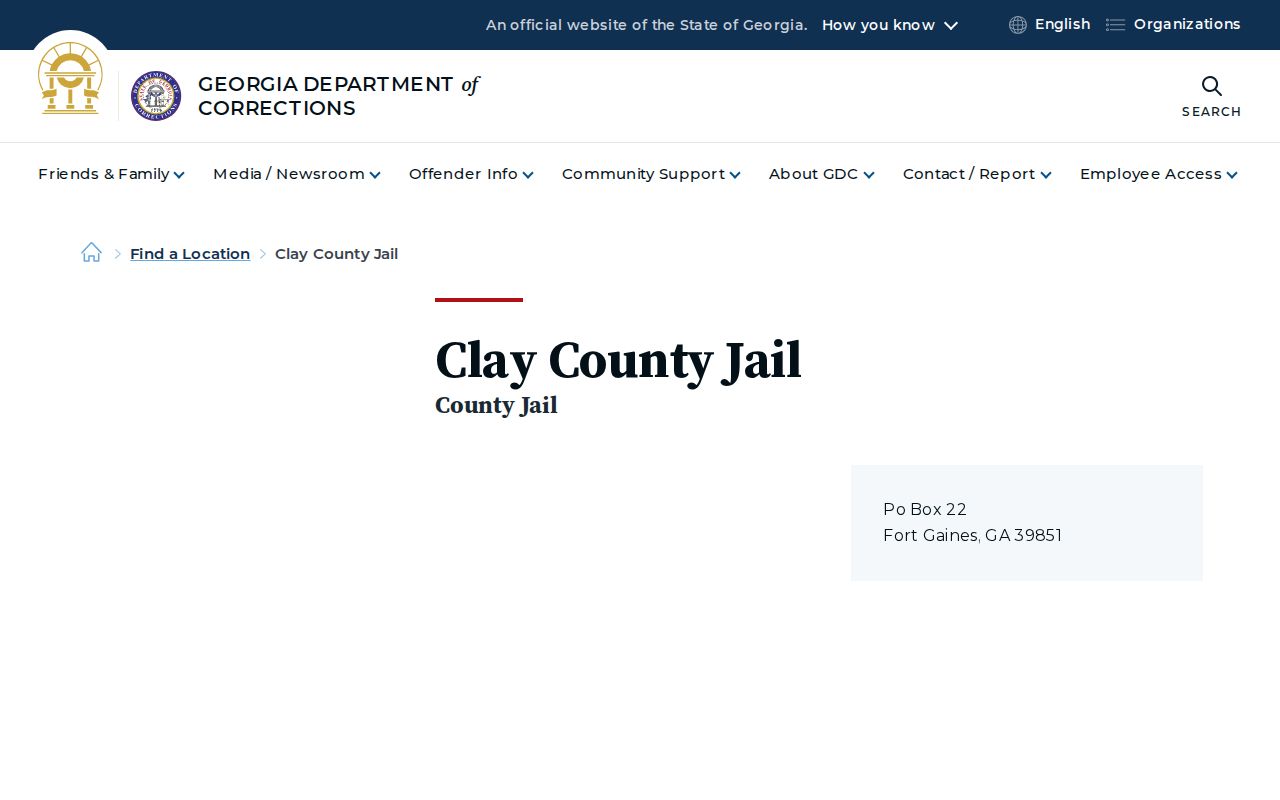
This state facility entry confirms the jail's identity and contact path, but it is not a live inmate roster.
Clay County Recent Arrests by City
Clay County has just two incorporated municipalities, per county civic material and the 2020 Census place table. A city name narrows down where an arrest happened. It does not tell you who made the arrest or who holds the record.
- Fort Gaines Recent Arrests: the city’s older public-safety page still lists a police department, while 2025 regional reporting described a transition toward sheriff coverage. Verify whether the city or sheriff holds the report.
- Bluffton Recent Arrests: no separate Bluffton police department or municipal arrest log was located, so the researched path begins with the county sheriff.
Both cities route back to Clay County Jail as the likely booking point. Confirm that for the specific event. Fort Gaines is the county seat. Bluffton is its own incorporated town, not a separate custody system.
Note: a municipality is where an event occurred. The arresting agency, booking agency, and records custodian may be different offices entirely.
Clay County Arrest Record Fields
A booking record gets created during intake. Clay's sheriff confirms booking reports, bonding reports, photographs, fingerprints, and criminal histories. No sample record is published, so no standard field set is guaranteed. A responsive record may include some of the items listed here. Treat the table as a request inventory. It is not a promise that every field is public or appears in every Clay County record.
| Field to request | How to interpret it |
|---|---|
| Booking or agency number | An identifier supplied by the custodian; Clay publishes no format |
| Arrest and booking time | Separate the event from jail intake and later publication |
| Arresting agency | Important where Fort Gaines city and sheriff roles differ |
| Booked charge | The intake charge |
| Bond report | Amount, type, or status if recorded and releasable |
| Booking photograph | An identification image |
| Facility or transfer | Where custody was recorded at that time |
| Court reference | A lead for the later docket, not a guaranteed field |
Fingerprints and criminal-history data can carry access limits beyond a basic booking report. Juvenile material may be withheld or redacted. Victim-identifying details, medical records, sealed files, and investigative content may be withheld or redacted too. Georgia's juvenile authorities will not even confirm whether a youth is in their system. A missing youth record proves nothing either way.
Request Clay County Arrest Records
No dedicated booking-record form or named custodian exists for Clay County. The same goes for a local photo fee or promised turnaround. Start with a phone call to the sheriff at 229-768-2505. Directory sources place the office at 124 Thomas Street, Suite 1, Fort Gaines, GA 39851. The email is claysheriff@claycountyga.net. The county offices page lists a different street address. Confirm the right delivery or mailing spot before you send anything or stop by.
- Describe existing records: the booking report, bonding report, and booking photograph for a named person within a narrow date range.
- Ask for the booking number and arresting agency if releasable.
- Request an itemized estimate before work that may incur charges.
- Ask for the statutory basis for each denial or redaction.
- Use the court clerk separately for filed charges, hearings, and disposition.
Georgia gives you some flexibility in how you ask for Clay County arrest records. The Georgia Attorney General's Open Records guidance allows a request to be oral or written. Putting it in writing fixes the scope. A phone call cannot do that. Agencies usually answer within three business days, though that reply may only cover timing and cost. Production itself can take longer. An agency has no duty to build a custom report. It never kept one in the first place. The county address conflicts across sources, so a quick phone call makes sense, and the Georgia Sheriffs' Association directory backs up the main contact details.
Clay County Arrest Photos
Clay County keeps booking photographs, the sheriff says. None appear on a public roster, though. A booking photo can still sit in the agency's file even when no website displays it. Ask for the image separately from the report. The records custodian then applies Georgia law to the request.
O.C.G.A. § 35-1-19 defines a booking photograph and limits what an arresting agency or its agent may post on a website, subject to statutory exceptions. The same statute covers disclosure to a requester who might publish the image through a fee-for-removal model. So the truth sits between two myths. Not every mugshot is public online. Not every mugshot is sealed forever either. A booking image simply identifies the person arrested and booked at the Clay County Jail.
State prison is different ground. The Georgia Department of Corrections may display a photo for someone in state custody, though it warns that photos are not always available. That state image is not the original county booking photo, and it does not cover someone merely arrested in Clay County, held before trial, or already released from the county jail.
Georgia Arrest Photo Removal Law
Four separate actions are often mistaken for one. An agency can correct its own record or page. A prosecutor, court, or GBI process may restrict qualifying criminal-history access. An outside publisher controls its copy under law and policy. A search engine can refresh an old result after the source changes. Success in one channel does not automatically alter the others.
The Georgia Attorney General’s mugshot guidance explains O.C.G.A. § 10-1-393.5. In specified eligible outcomes, including certain dismissals, acquittals, or non-referrals, a covered commercial publisher must use a free removal process after receiving the required written request and identifying details through the prescribed delivery method. This is not a universal erasure rule. Do not pay an intermediary merely to make a request that state law may require a covered publisher to process without a fee.
Record restriction under O.C.G.A. § 35-3-37 can limit access through certain criminal-history channels after the proper process. Arrest date and disposition matter. Georgia Courts warns that local files, court records, news reports, or private copies may remain. After a source changes, Google may refresh its result, but it cannot delete a live source.
The official consumer-protection page presents the lawful route without displaying a gallery.
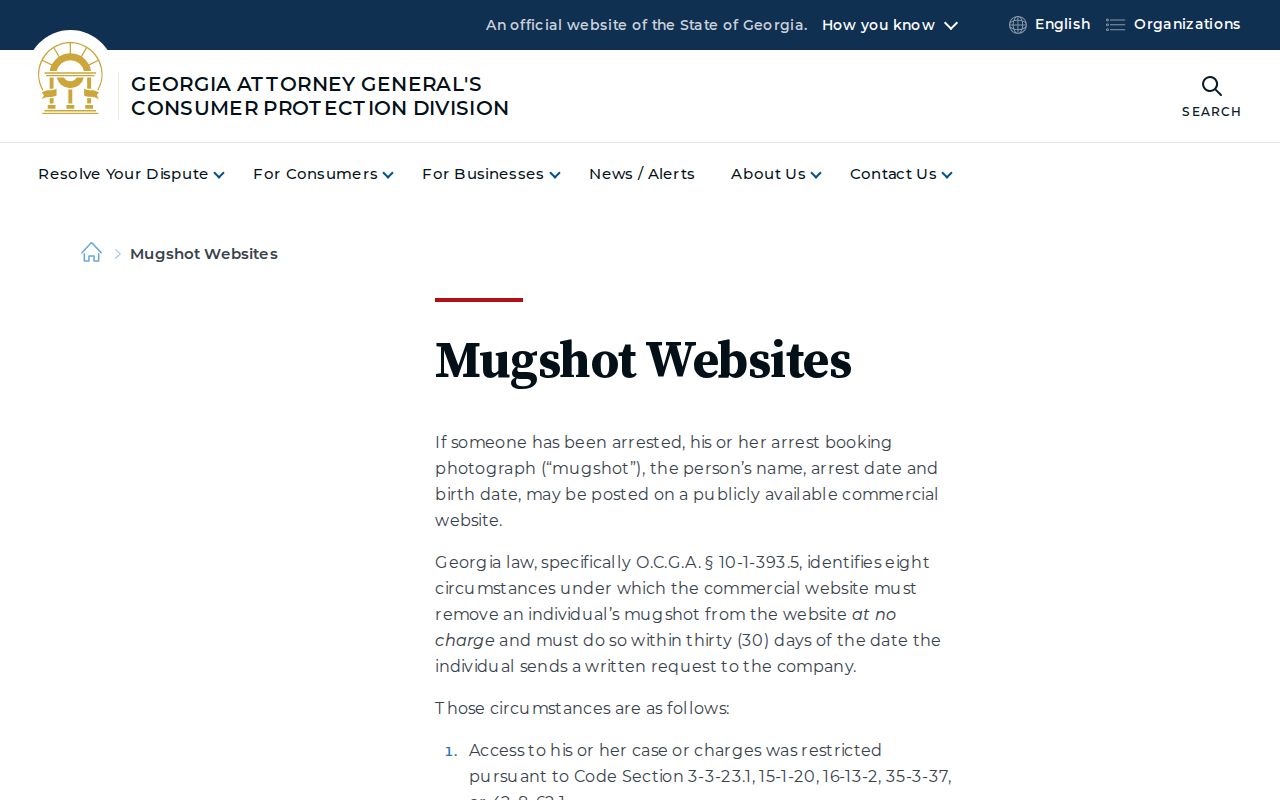
Note: check this guidance against the current statute and the actual case outcome before sending any removal request.
Clay County Arrest Warrants
A Clay County warrant starts as a tool of the courts. The sheriff's office is the agency that carries them out. There is no public warrant-search portal for this county. No most-wanted page is run from the Clay County seat either. That gap matters. Search engines will happily serve up warrant lists from other states that also have a Clay County. Treat those as unrelated. Skip any outside count, update schedule, reward offer, or tip line that does not belong to this county.
The sheriff's office answers questions directly at 229-768-2505. Staff can tell you what they will confirm by phone. For a paper trail, the Clay Superior Clerk at 229-768-2631 handles the court-file route. Online eAccess may open a participating court's records. A lawyer or the court itself is the right call when a warrant touches you personally. Never confront anyone you believe is wanted. Route safety tips straight to law enforcement.
What a warrant means is simple enough. It is judicial authority for an arrest or some other stated action. A bench version typically follows a missed court requirement. Old listings from third-party sites prove nothing, because a warrant can be recalled or resolved at any time.
Clay Arrests Reach the Court
A booking report shows one thing. It captures what the jail recorded on the day of an arrest in Clay County. The court docket tells a different story. From there, a case in Clay County can run through first appearance, a bond ruling, formal charges, arraignment, motions, plea or trial, sentencing, and later orders, though not every matter hits every step.
- Arraignment
- A hearing where the formal charge is presented and a plea may be entered.
- Bond
- Terms governing release while a case is pending; release is not acquittal.
- Disposition
- The recorded outcome, such as dismissal, acquittal, plea, or conviction.
- Restriction
- A Georgia process limiting specified criminal-history access when legal conditions are met.
Georgia Courts eAccess names PeachCourt as the portal for Clay Superior Court, though an account may be needed. A failed search has a fallback. The Clay Superior Court clerk sits at 210 Washington Street South, Suite 3, Fort Gaines, and answers the phone at 229-768-2631 on weekdays from 8:00 a.m. to 4:30 p.m. Probate Court handles traffic and arraignments separately. The official eAccess overview shows why a court search never substitutes for a jail roster.
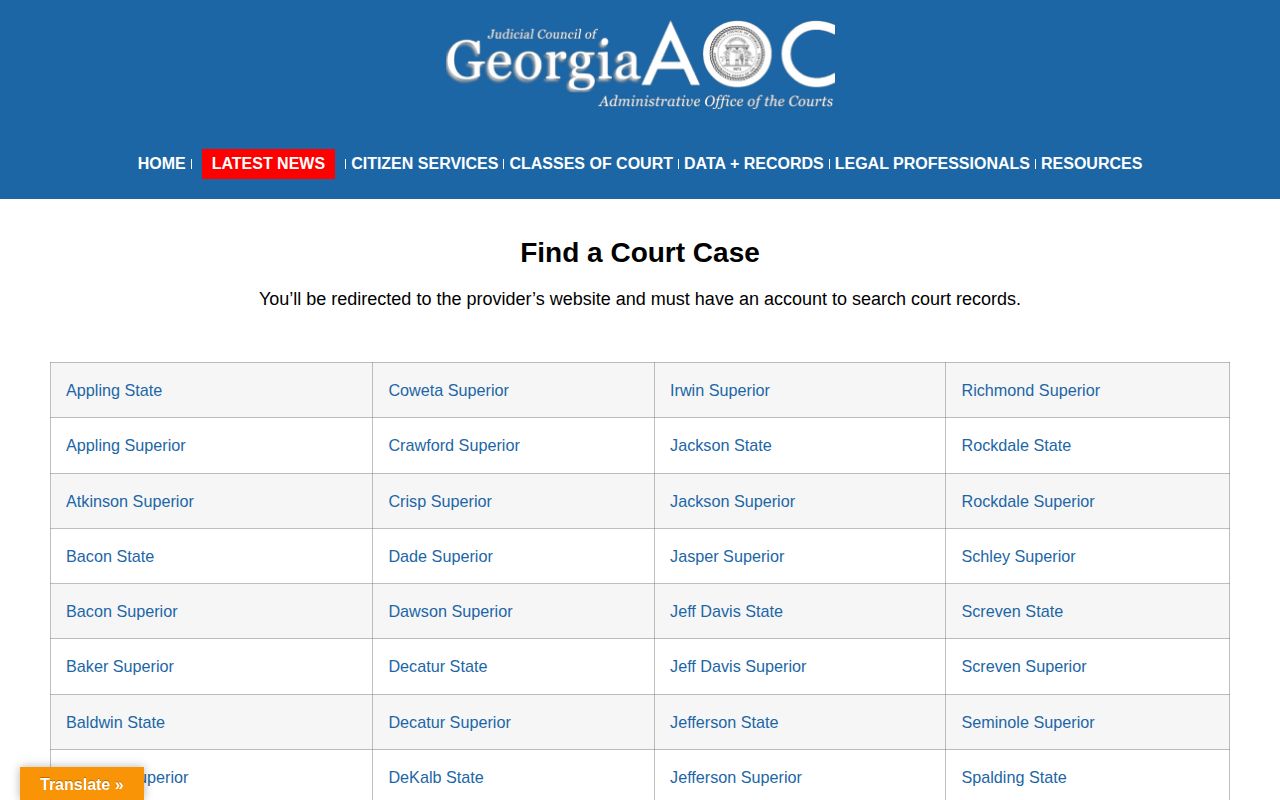
The court channel supplies the procedural record that a booking report cannot provide.
Clay County Arrest Custody Alerts
Georgia rolled out automated victim notifications statewide in 2024 through VINE and Appriss. Clay County posts no technical page explaining its side of the system. The jail's upload interval stays undocumented. The data fields are unclear too. To get custody alerts by phone, online, or mobile, start with the VINELink custody check, search a name, and register for updates when a matching record allows it. Then confirm any no-result with the sheriff. An alert can flag release, transfer, or escape. A statewide tool and a county feed are different claims, and Clay lists no booking app or official photo feed for arrests.
Clay Arrest News and Directories
Official sources come first for Clay County arrest news. WALB's Clay archive and the Albany Herald public-safety archive offer selective regional reporting, including the Fort Gaines policing change. Editors pick those stories. Publication time is not booking time. A quiet archive does not mean nobody was arrested in Clay County. Mugshots.com has a Clay County, Georgia section. JailMugshots.org keeps a county directory page too. Both are unofficial. Neither proves present custody, full coverage, or the final court result for a Clay arrest. The directory also shows contact details that conflict with the official GDC directory and links to unrelated Clayton County material. RecentlyBooked, Busted Newspaper, Mugshots.zone, and Arrests.org list no Georgia Clay section. The page from Mugshots.com simply maps the unofficial territory that opens up after official channels.
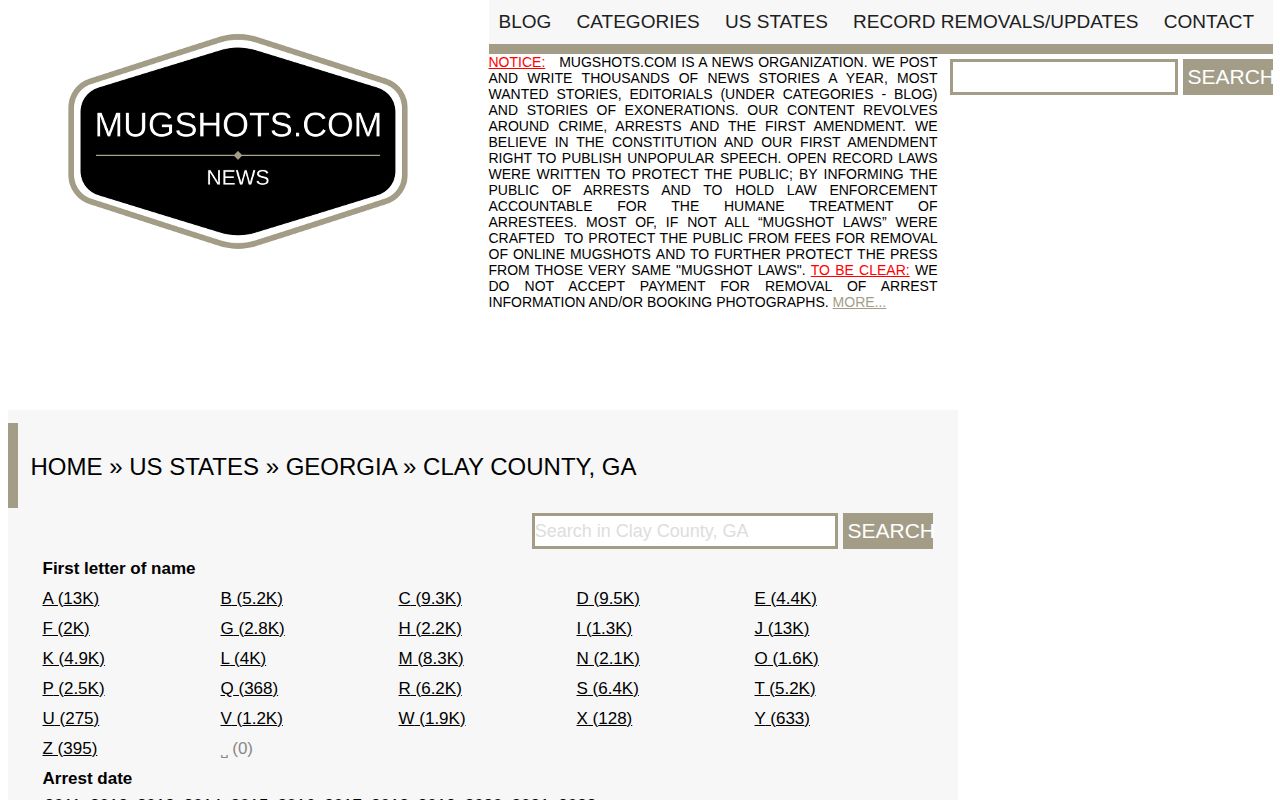
Old or incomplete entries can appear on outside pages. Check every identity, status, and disposition with the office responsible for the record.
Clay County Booking Record Retention
Online visibility and government retention are separate things. Georgia Archives schedules set the clocks. Daily incarceration lists last one year. Jail booking records are kept ten years after release, and jail registers ten years after the last entry. Fugitive or wanted-person files run five years after apprehension. Holding-cell recordings get a much shorter period. These statewide categories do not promise that Clay County keeps each item in the same format or posts it online for that whole span. Ask the Clay custodian which approved schedule series applies. Also ask whether a legal hold blocks disposal and whether an older arrest record moved to another local office. Georgia Archives says county records usually stay with local offices rather than moving to the State Archives. So the sheriff or court clerk is the first archive contact for a recent Clay arrest.
A 2007 planning document sketched an older arrangement. Back then, Clay lacked a jail and contracted with Miller County. That history stays history, since the current GDC directory lists Clay County Jail and today's arrest questions belong with today's contacts.
Clay Records Beyond County Custody
State custody sits beyond the county jail. The GDC Find an Offender tool covers Georgia prison custody, and its search accepts a GDC ID, case number, or name criteria. A photo may appear when one exists. The tool does not track every recent Clay arrest, ordinary county pretrial custody, or someone released on bond. Match more than a name before trusting a result. Federal systems hold different populations. The BOP locator lists federal prisoners from 1982 forward. It works as a prisoner locator, not a Clay booking-photo source. The ICE locator covers qualifying immigration custody and enforces exact identifier rules. The Marshals Service may house a federal detainee locally but rarely releases federal prisoner photographs.
The sequence is simple. Sheriff first for county intake, court clerk for the case, VINE for available alerts, GDC after movement into state custody, and BOP, USMS, or ICE only when their jurisdiction applies. Each source records one slice of a person's status.